

What Is a Motor Grader and What Tires Does It Need?
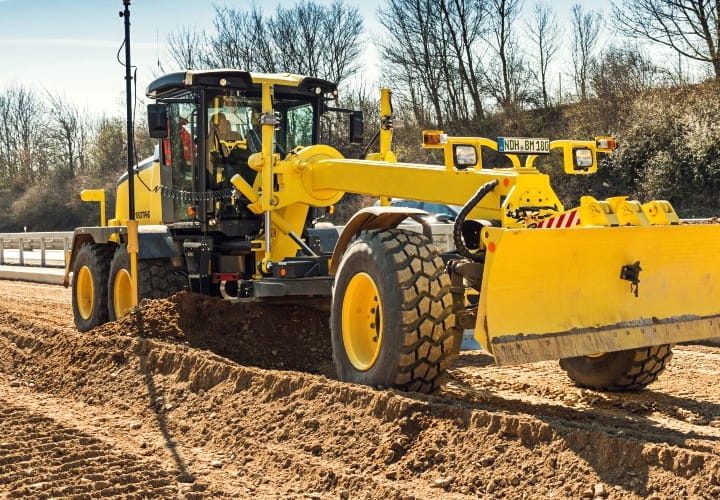
A motor grader is a construction machine used for leveling and creating flat surfaces in road construction, earthworks, and site preparation. Graders are among the oldest machines in earthmoving: the first grader was built in 1876 by the Champion company and initially pulled by horses. The first true motor grader was produced in 1921 by the American Rippel Corporation, and the first European motor grader followed in 1927 in Norway. Modern motor graders carry their weight on six tires, distributed across the front axle and a driven tandem rear axle. This design ensures even weight distribution, smooth operation, and low ground compaction without sacrificing the required traction.
Operating Conditions and Loads on Grader Tires
Grader tires operate under widely varying conditions. During actual grading work, the machine moves slowly but must transmit high lateral forces and constant pressure to the ground. When traveling between job sites, motor graders can reach transport speeds of up to 40 kilometers per hour. The carcass and tread of Trelleborg grader tires are engineered to provide reliable grip and precise directional stability in both situations -- on sand, rock, gravel, and soil alike.
Bias-Ply and Radial Tires for Graders
Trelleborg offers two tire constructions for motor graders. Bias-ply tires feature a cross-layered ply structure that makes the tire particularly robust and cut-resistant -- a clear advantage on sharp-edged gravel and unpaved construction surfaces. Radial tires run perpendicular to the direction of travel, providing a larger contact patch, lower rolling resistance, and more ride comfort during longer transport runs. The multi-surface tread design delivers reliable grip on a wide variety of ground conditions in both cases.
Frequently Asked Questions About Grader Tires
Want to get in touch? Drop us a line and we’ll get back to you as soon as possible.